

Types of Investment Accounts in Canada: The Blindspot
Table of Contents
You’re probably leaving millions on the table right now. And you don’t even know it.
That’s not a scare tactic – it’s math. Canada has one of the most generous registered accounts systems in the world. The government offers tax deductions, tax-free growth, and even government grant money. The average Canadian who doesn’t fully use their registered accounts leaves significant tax-sheltered retirement wealth on the table.
Not to poor performance. Not to fees. It’s lost forever because of missed tax-free growth, government grants, and compounding. All from a simple lack of understanding about registered and non-registered investments and which to use when.
The Real Cost of Not Knowing [Example]
Consider Sarah, a 35-year-old professional, earning $75,000 per year. She contributes $3,000 annually to her RRSP that’s roughly 22% of her available $13,500 limit (18% of her annual salary). Over 30 years, assuming an average annual return of7%:
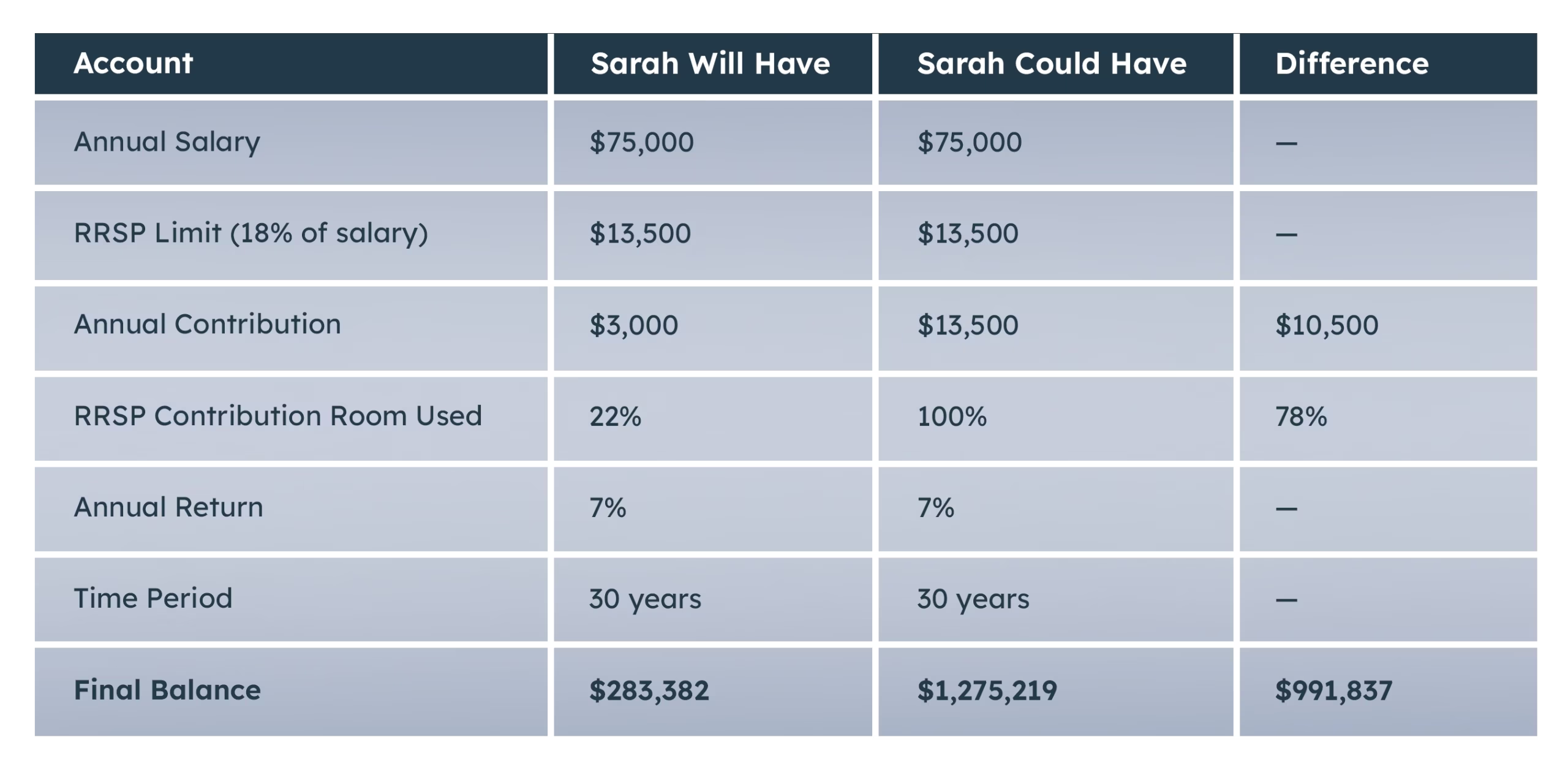
Hypothetical example. For simplicity, the annual salary is kept constant for the full 30-year period. For illustrative purposes only.
Sarah isn’t lazy or irresponsible. She simply doesn’t realize that by leaving her contribution room underutilized, she is effectively walking away from nearly one million dollars in retirement wealth. She hasn’t been shown how to strategically navigate the landscape of registered accounts and investment planning Canada.
You don’t have to be Sarah.
What You’ll Discover in This Guide
By the time you finish reading, you’ll understand:
- The 7 types of investments accounts – registered accounts Canadians should know (not just RRSP and TFSA)
- How to choose between registered and non-registered investment accounts
- Why private real estate investmentmay be a powerful diversifier, especially inside registered accounts
- How the First-Time Home Buyer’s Plancan create a “double dip” effect in the right scenario
- Practical, decision-ready steps you can use immediately
Canadians already hold trillions in registered plans. The difference is that wealthier households don’t just “save” they deploy capital intentionally across diversified investment opportunities in Canada, using account rules like a playbook.
Understanding Registered and Non-Registered Investments: The Foundation of Wealth Building
Before we dive into the specific accounts that could transform your financial future, you need to understand the fundamental difference between registered and non-registered investments. This is the knowledge gap that separates the wealthy from the hopeful.
Registered Accounts: Your Government-Sanctioned Wealth Accelerators
Registered accounts are investment vehicles registered with the Canada Revenue Agency (CRA) that offer various tax advantages. Think of them as the government saying: “We want you to save for retirement, education, and emergencies so much so that we’re willing to give you massive tax breaks to do it.”
These advantages include:
- Tax-deferred growth (you are not taxed until you withdraw the money)
- Tax-free growth (you never pay tax on investment gains, interest and dividends)
- Tax deductions on contributions (reduce your taxable income for the year)
- Government matching grants (government money added on top of your own contributions)
According to 2024 CRA data, approximately 60% of Canadian tax filers contribute to at least one type of registered accounts annually. But here’s the kicker: most of them are only scratching the surface of what’s possible.
Non-Registered Accounts: When Unlimited Beats Tax-Advantaged
Non-registered accounts don’t offer the same tax shelters. Investment income earned in these accounts including interest, dividends, and capital gains is taxable in the year it’s earned. However, they offer two powerful advantages:
- Unlimited contribution room (no government caps on how much you invest)
- Complete flexibility (withdraw anytime without penalties or restrictions)
According to the Investment Funds Institute of Canada, Canadians held approximately $1.8 trillion in non-registered investment accounts in 2023, compared to over $3 trillion in registered accounts.
The wealthy don’t choose one over the other; they strategically use both.
The Numbers Don’t Lie
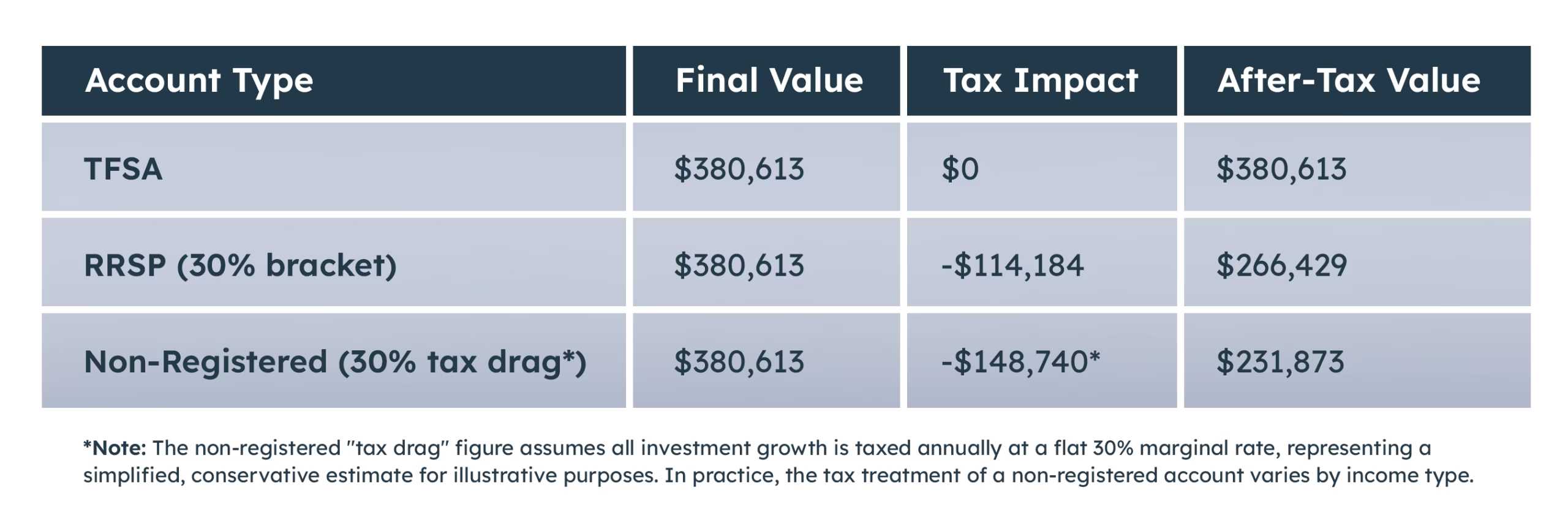
Let’s look at real math using Sarah’s example again. Assume she invested $50,000 and let it grow for 30 years at an average annual return of 7%:
The “Quiet” Penalty
By leaving that money in a non-registered account, Sarah faces two massive hurdles:
- The TFSA Gap: She ends up with $148,740 less than she would have in a TFSA.
- The RRSP Advantage: Even after paying a high 30% tax on withdrawal (for simplicity assuming Sarah is in the same tax bracket when she contributes and upon withdrawal), the RRSP still beats the non-registered account by $34,556.
This is why understanding your account options isn’t just “good paperwork”- it is literally worth six figures over your lifetime.
The 7 Types of Registered Accounts Canadians Should Know
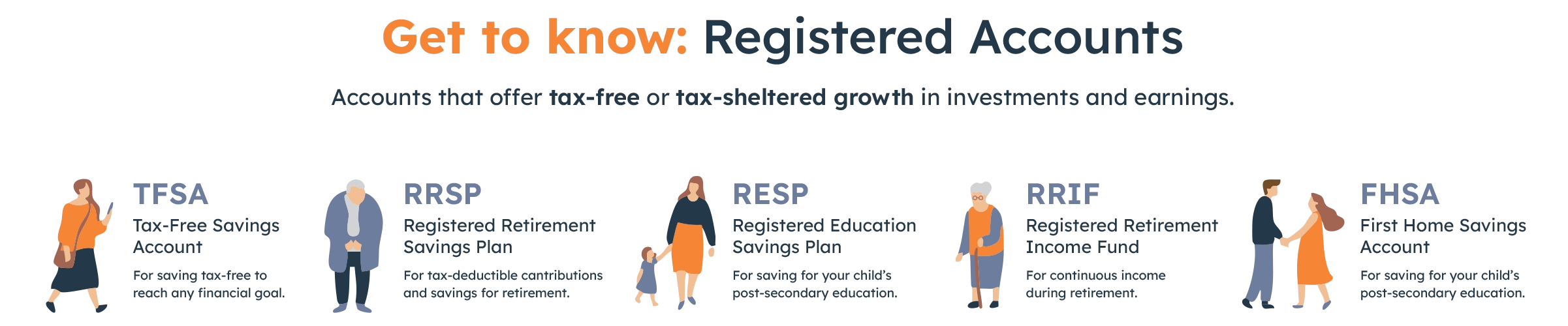
Most people stop at RRSP and TFSA. That’s the mistake. Here are seven registered account types that matter—and what they’re intended for.
1) RRSP (Registered Retirement Savings Plan): The Tax-Deduction Powerhouse
Best for: high earners today who expect a lower tax rate later.
Why it’s powerful:
- Contributions are tax-deductible
- Investments grow tax-deferred
Taxes are paid on withdrawal (often in retirement)
Your RRSP contribution limit is generally 18% of prior-year earned income up to an annual maximum (the max changes yearly). The bigger issue isn’t the limit; it’s the unused room. That’s where the lifetime cost compounds.
The First-Time Home Buyer’s Plan (HBP)
The First-Time Home Buyer’s Plan allows eligible buyers to withdraw up to $60,000 from an RRSP to buy or build a qualifying first home (subject to rules and repayment schedules). In the right setup, it can feel like a “double dip”:
- contribute to RRSP → potentially get a tax refund
- withdraw under HBP → use funds toward a down payment
- repay over time → restore retirement savings gradually
It’s not “free money,” but it can be a useful bridge if done intentionally.
The Lifelong Learning Plan can allow RRSP withdrawals for education (again, with rules and repayment requirements). Useful for career changes, upskilling, or funding a program without immediately triggering tax consequences.
2) TFSA (Tax-Free Savings Account): The Flexibility Champion
Best for: almost everyone, especially for flexibility and long-term tax-free compounding.
Why it’s powerful:
- Contributions are not deductible
- Growth is tax-free
- Withdrawals are tax-free
- Contribution room is generally added back the year following a withdrawal
TFSA room accumulates annually and carries forward. The TFSA is ideal for:
- emergency funds (if invested conservatively)
- Medium to long term goals
- retirement (especially when combined with RRSP planning)
- high-growth investing where tax-free gains matter
Approximately 40% of Canadians underuse the TFSA by treating it like a savings account instead of an investment vehicle- missing years of potential tax-free growth.
3) RESP (Registered Education Savings Plan): Government Grants for Education
Best for: parents/guardians saving for a child’s education.
Why it’s powerful:
- Growth is tax-sheltered inside the plan
- Withdrawals for education are typically taxed in the student’s hands (often low)
- The government adds grants:
- The Canada Education Savings Grant (CESG) can add 20% on eligible contributions (up to annual and lifetime limits)
- Some families may qualify for the Canada Learning Bond (CLB)
If you contribute strategically (often targeting the amount that maximizes CESG), you’re capturing one of the clearest “free money” incentives available in Canada.
4) FHSA (First Home Savings Account): RRSP + TFSA Features (For a Home)
Best for: eligible first-time home buyers building a down payment.
Why it’s powerful:
- Contributions can be tax-deductible (like an RRSP)
- Qualifying withdrawals for a first home can be tax-free (like a TFSA)
- Unused contribution room can generally be carried forward (within program rules)
If you don’t buy, you may be able to roll it into an RRSP/RRIF in many cases (subject to rules)
For many first-time buyers, the FHSA should be near the top of the investment priority framework – often even before additional RRSP contributions because of the combined deduction + tax-free withdrawal design.
5) RDSP (Registered Disability Savings Plan): The Most Overlooked Wealth Tool
Best for: Canadians eligible for the Disability Tax Credit (DTC) and their families.
Why it’s powerful:
- Growth inside the plan is tax-sheltered
- The Canada Disability Savings Grant (CDSG) matches contributions at rates of 100%, 200%, or 300% depending on family net income – up to $3,500 per year, with a lifetime maximum of $70,000
- The Canada Disability Savings Bond (CDSB) provides up to $1,000 per year (lifetime max: $20,000) to lower-income families with no contributions required to receive it
- The plan is designed for long-term financial security, with grants and bonds encouraging a long-term hold
The catch most people don’t know about: RDSP funds typically must remain in the plan for at least 10 years after the last government contribution or repayment rules apply. This makes it a long-term vehicle but for families planning ahead, that’s often exactly what’s needed.
If you or a family member qualifies for the DTC and you don’t have an RDSP open, there’s a strong case for making it a priority. Unclaimed grants and bonds from prior years can often be retroactively accessed (going back up to 10 years), meaning there may be significant government money waiting to be claimed.
6) RRIF (Registered Retirement Income Fund): The RRSP “Pay cheque” Phase
Best for: turning retirement savings into income.
RRIF isn’t where you typically build wealth; it’s where RRSP savings often go when you start drawing retirement income. RRSPs usually must be converted by the end of the year you turn 71 (common route: RRIF), after which minimum withdrawals apply.
Why it matters:
- Withdrawal planning affects taxes, benefits, and cash flow
- Coordinating RRIF withdrawals with TFSA strategy can reduce lifetime tax
7) Locked-In Retirement Accounts (LIRA / Locked-In RRSP): Pension Money Rules
Best for: Canadians leaving an employer pension who transfer commuted value.
A LIRA (and related locked-in accounts) holds pension-transferred funds with restrictions designed to preserve retirement income. You generally can’t withdraw freely like an RRSP.
Why it matters:
- It’s a key bucket in many Canadians’ retirement picture
- Understanding withdrawal rules later (LIF, unlocking provisions in some jurisdictions) helps prevent surprises
A Simple Investment Priority Framework (That Prevents Costly Mistakes)
There is no one-size-fits-all, however, many Canadians use this priority framework:
- Employer match plans first (e.g., group RRSP/DPSP matches), instant return
- Paying off High-interest debt delivers guaranteed after-tax win equal to the tax interest rate you’re eliminating.
- FHSA (if eligible and buying in the future)
- TFSA (especially for flexibility and tax-free growth)
- RRSP (particularly in higher tax brackets, or for HBP/LLP strategies)
- RESP / RDSP (if applicable and grants/bonds available)
- Non-registered investing once registered room is optimized
The exact order can change based on income, timeline, benefits, and goals, but the point is to make t a system, not a guess.
You’re probably leaving millions on the table right now. And you don’t even know it.
That’s not a scare tactic – it’s math. Canada has one of the most generous registered accounts systems in the world. The government offers tax deductions, tax-free growth, and even government grant money. The average Canadian who doesn’t fully use their registered accounts leaves significant tax-sheltered retirement wealth on the table.
Not to poor performance. Not to fees. It’s lost forever because of missed tax-free growth, government grants, and compounding. All from a simple lack of understanding about registered and non-registered investments and which to use when.
The Real Cost of Not Knowing [Example]
Consider Sarah, a 35-year-old professional, earning $75,000 per year. She contributes $3,000 annually to her RRSP that’s roughly 22% of her available $13,500 limit (18% of her annual salary). Over 30 years, assuming an average annual return of 7%:
Hypothetical example. For simplicity, the annual salary is kept constant for the full 30-year period.
For illustrative purposes only.
Sarah isn’t lazy or irresponsible. She simply doesn’t realize that by leaving her contribution room underutilized, she is effectively walking away from nearly one million dollars in retirement wealth. She hasn’t been shown how to strategically navigate the landscape of registered accounts and investment planning in Canada.
You don’t have to be Sarah.
What You’ll Discover in This Guide
By the time you finish reading, you’ll understand:
- The 7 types of investments accounts – registered accounts Canadians should know (not just RRSP and TFSA)
- How to choose between registered and non-registered investment accounts
- Why private real estate investment may be a powerful diversifier, especially inside registered accounts
- How the First-Time Home Buyer’s Plan can create a “double dip” effect in the right scenario
- Practical, decision-ready steps you can use immediately
Canadians already hold trillions in registered plans. The difference is that wealthier households don’t just “save” they deploy capital intentionally across diversified investment opportunities in Canada, using account rules like a playbook.
Understanding Registered and Non-Registered Investments: The Foundation of Wealth Building
Before we dive into the specific accounts that could transform your financial future, you need to understand the fundamental difference between registered and non-registered investments. This is the knowledge gap that separates the wealthy from the hopeful.
Registered Accounts: Your Government-Sanctioned Wealth Accelerators
Registered accounts are investment vehicles registered with the Canada Revenue Agency (CRA) that offer various tax advantages. Think of them as the government saying: “We want you to save for retirement, education, and emergencies so much so that we’re willing to give you massive tax breaks to do it.”
These advantages include:
- Tax-deferred growth (you are not taxed until you withdraw the money)
- Tax-free growth (you never pay tax on investment gains, interest and dividends)
- Tax deductions on contributions (reduce your taxable income for the year)
- Government matching grants (government money added on top of your own contributions)
According to 2024 CRA data, approximately 60% of Canadian tax filers contribute to at least one type of registered accounts annually. But here’s the kicker: most of them are only scratching the surface of what’s possible.
Non-Registered Accounts: When Unlimited Beats Tax-Advantaged
Non-registered accounts don’t offer the same tax shelters. Investment income earned in these accounts including interest, dividends, and capital gains is taxable in the year it’s earned. However, they offer two powerful advantages:
- Unlimited contribution room (no government caps on how much you invest)
- Complete flexibility (withdraw anytime without penalties or restrictions)
According to the Investment Funds Institute of Canada, Canadians held approximately $1.8 trillion in non-registered investment accounts in 2023, compared to over $3 trillion in registered accounts.
The wealthy don’t choose one over the other; they strategically use both.
The Numbers Don’t Lie
Let’s look at real math using Sarah’s example again. Assume she invested $50,000 and let it grow for 30 years at an average annual return of 7%:
The “Quiet” Penalty
By leaving that money in a non-registered account, Sarah faces two massive hurdles:
- The TFSA Gap: She ends up with $148,740 less than she would have in a TFSA.
- The RRSP Advantage: Even after paying a high 30% tax on withdrawal (for simplicity assuming Sarah is in the same tax bracket when she contributes and upon withdrawal), the RRSP still beats the non-registered account by $34,556.
This is why understanding your account options isn’t just “good paperwork”- it is literally worth six figures over your lifetime.
The 7 Types of Registered Accounts Canadians Should Know
Most people stop at RRSP and TFSA. That’s the mistake. Here are seven registered account types that matter—and what they’re intended for.
1) RRSP (Registered Retirement Savings Plan): The Tax-Deduction Powerhouse
Best for: high earners today who expect a lower tax rate later.
Why it’s powerful:
- Contributions are tax-deductible
- Investments grow tax-deferred
Taxes are paid on withdrawal (often in retirement)
Your RRSP contribution limit is generally 18% of prior-year earned income up to an annual maximum (the max changes yearly). The bigger issue isn’t the limit; it’s the unused room. That’s where the lifetime cost compounds.
The First-Time Home Buyer’s Plan (HBP)
The First-Time Home Buyer’s Plan allows eligible buyers to withdraw up to $60,000 from an RRSP to buy or build a qualifying first home (subject to rules and repayment schedules). In the right setup, it can feel like a “double dip”:
- contribute to RRSP → potentially get a tax refund
- withdraw under HBP → use funds toward a down payment
- repay over time → restore retirement savings gradually
It’s not “free money,” but it can be a useful bridge if done intentionally.
The Lifelong Learning Plan can allow RRSP withdrawals for education (again, with rules and repayment requirements). Useful for career changes, upskilling, or funding a program without immediately triggering tax consequences.
2) TFSA (Tax-Free Savings Account): The Flexibility Champion
Best for: almost everyone, especially for flexibility and long-term tax-free compounding.
Why it’s powerful:
- Contributions are not deductible
- Growth is tax-free
- Withdrawals are tax-free
- Contribution room is generally added back the year following a withdrawal
TFSA room accumulates annually and carries forward. The TFSA is ideal for:
- emergency funds (if invested conservatively)
- retirement (especially when combined with RRSP planning)
- high-growth investing where tax-free gains matter
Approximately 40% of Canadians underuse the TFSA by treating it like a savings account instead of an investment vehicle- missing years of potential tax-free growth.
3) RESP (Registered Education Savings Plan): Government Grants for Education
Best for: parents/guardians saving for a child’s education.
Why it’s powerful:
- The government adds grants:
- The Canada Education Savings Grant (CESG) can add 20% on eligible contributions (up to annual and lifetime limits)
- Some families may qualify for the Canada Learning Bond (CLB)
If you contribute strategically (often targeting the amount that maximizes CESG), you’re capturing one of the clearest “free money” incentives available in Canada.
4) FHSA (First Home Savings Account): RRSP + TFSA Features (For a Home)
Best for: eligible first-time home buyers building a down payment.
Why it’s powerful:
- Contributions can be tax-deductible(like an RRSP)
- Qualifying withdrawals for a first home can be tax-free(like a TFSA)
- Unused contribution room can generally be carried forward (within program rules)
If you don’t buy, you may be able to roll it into an RRSP/RRIF in many cases (subject to rules)
For many first-time buyers, the FHSA should be near the top of the investment priority framework – often even before additional RRSP contributions because of the combined deduction + tax-free withdrawal design.
5) RDSP (Registered Disability Savings Plan): The Most Overlooked Wealth Tool
Best for: Canadians eligible for the Disability Tax Credit (DTC) and their families.
Why it’s powerful:
- Growth inside the plan is tax-sheltered
- The Canada Disability Savings Grant (CDSG) matches contributions at rates of 100%, 200%, or 300% depending on family net income – up to $3,500 per year, with a lifetime maximum of $70,000
- The Canada Disability Savings Bond (CDSB) provides up to $1,000 per year (lifetime max: $20,000) to lower-income families with no contributions required to receive it
- The plan is designed for long-term financial security, with grants and bonds encouraging a long-term hold
The catch most people don’t know about: RDSP funds typically must remain in the plan for at least 10 years after the last government contribution or repayment rules apply. This makes it a long-term vehicle but for families planning ahead, that’s often exactly what’s needed.
If you or a family member qualifies for the DTC and you don’t have an RDSP open, there’s a strong case for making it a priority. Unclaimed grants and bonds from prior years can often be retroactively accessed (going back up to 10 years), meaning there may be significant government money waiting to be claimed.
6) RRIF (Registered Retirement Income Fund): The RRSP “Pay cheque” Phase
Best for: turning retirement savings into income.
RRIF isn’t where you typically build wealth; it’s where RRSP savings often go when you start drawing retirement income. RRSPs usually must be converted by the end of the year you turn 71 (common route: RRIF), after which minimum withdrawals apply.
Why it matters:
- Withdrawal planning affects taxes, benefits, and cash flow
- Coordinating RRIF withdrawals with TFSA strategy can reduce lifetime tax
7) Locked-In Retirement Accounts (LIRA / Locked-In RRSP): Pension Money Rules
Best for: Canadians leaving an employer pension who transfer commuted value.
A LIRA (and related locked-in accounts) holds pension-transferred funds with restrictions designed to preserve retirement income. You generally can’t withdraw freely like an RRSP.
Why it matters:
- It’s a key bucket in many Canadians’ retirement picture
- Understanding withdrawal rules later (LIF, unlocking provisions in some jurisdictions) helps prevent surprises
A Simple Investment Priority Framework (That Prevents Costly Mistakes)
There is no one-size-fits-all, however, many Canadians use this priority framework:
- Employer match plans first(e.g., group RRSP/DPSP matches), instant return
- Paying off High-interest debt delivers guaranteed after-tax win equal to the tax interest rate you’re eliminating.
- FHSA(if eligible and buying in the future)
- TFSA(especially for flexibility and tax-free growth)
- RRSP(particularly in higher tax brackets, or for HBP/LLP strategies)
- RESP / RDSP(if applicable and grants/bonds available)
- Non-registered investingonce registered room is optimized
The exact order can change based on income, timeline, benefits, and goals, but the point is to make it a system, not a guess.
Unlock What’s Possible for Your Financial Future

Unlock What’s Possible for Your Financial Future
Private Real Estate Investment: The Asset Class That May Fit in Your Portfolio?
Now that you understand the accounts, here’s an asset class that may work particularly well inside them.
Why Real Estate Has Remained Attractive
Real estate has historically combined two things’ investors love:
- Income (rent or distributions)
- Appreciation (long-term value growth)
It also tends to behave differently than many other investments, meaning it may add diversification to a portfolio. Private real estate is often discussed as having smoother valuation paths (less day-to-day price movement), which can help investors stay disciplined.
The Tax Advantage Multiplier (When It Fits)
Here’s where it gets strategic: real estate income (and interest income generally) may be tax-inefficient in a taxable account.
When you hold tax-inefficient income-producing assets inside registered structures where growth is tax-deferred or tax-free, you can reduce tax drag and potentially improve long-term compounding.
This is why wealthy Canadians don’t just invest in real estate they are also strategic about where they hold it.
How to Combine Account Strategy with Asset Location
Once you have the account order, decide what goes where:
- Tax-inefficient income (interest-heavy strategies) often fits better in RRSP/RRIF (tax-deferred)
- High-growth assets can shine in a TFSA (tax-free gains)
- Education timelines often call for a glide path in a RESP
- Exposure to long-term investments, including private real estate investment , can be considered inside registered and non-registered accounts if eligible and profile suitable
This is called “asset location”: not just what you buy, but where you hold it.
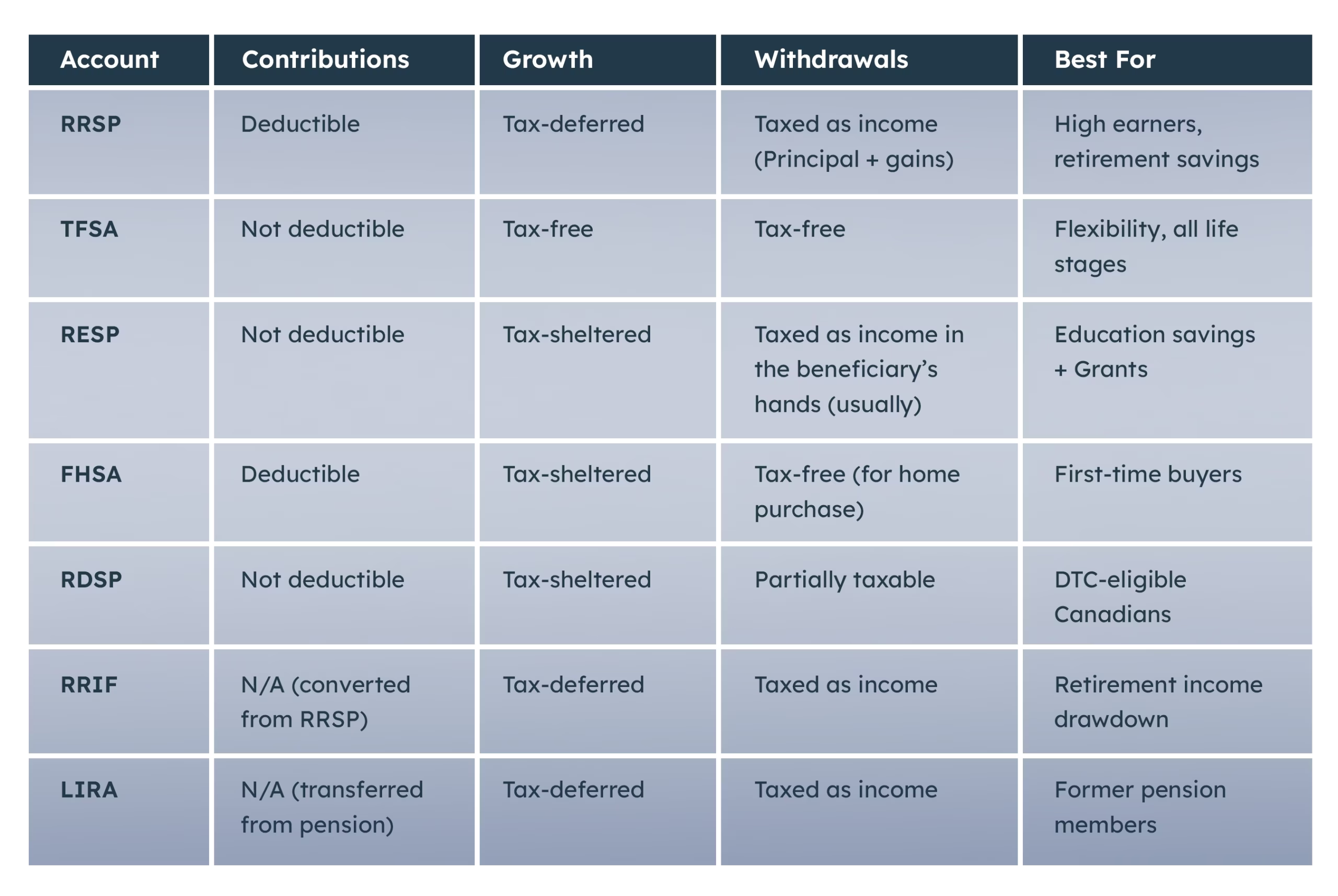
Quick Reference: Registered Accounts at a Glance
The Bottom Line: The Seven Figures You Don’t Have to Lose
Remember Sarah? In our example, she’d retire with $283,000. She could have had $1.27M. The difference wasn’t lucky, and it wasn’t income – it was knowing which accounts to use and actually using them to their full potential. You have the same choice.
The accounts exist. The tax advantages are real. The government grants are sitting there waiting to be claimed. And the gap is still closeable. But time isn’t.
Here’s what to do next:
- Check how much RRSP contribution room you have (log into CRA My Account and account for contributions in the current year)
- Compare TFSA contribution room and consider contributions from the current year as well
- Find out if you or a family member is eligible for the FHSA, RDSP, or CESG grants through a RESP
- Build a clear investment priority framework and fund the right accounts consistently even if the amounts feel modest at first
Compounding doesn’t care how you start. It only cares that you do.
*The information provided in this article is for informational purposes only and is not intended as financial, tax, or investment advice. Please consult a qualified professional before making any financial decisions.
Private Real Estate Investment: The Asset Class That May Fit in Your Portfolio?
Now that you understand the accounts, here’s an asset class that may work particularly well inside them.
Why Real Estate Has Remained Attractive
Real estate has historically combined two things’ investors love:
- Income (rent or distributions)
- Appreciation (long-term value growth)
It also tends to behave differently than many other investments, meaning it may add diversification to a portfolio. Private real estate is often discussed as having smoother valuation paths (less day-to-day price movement), which can help investors stay disciplined.
The Tax Advantage Multiplier (When It Fits)
Here’s where it gets strategic: real estate income (and interest income generally) may be tax-inefficient in a taxable account.
When you hold tax-inefficient income-producing assets inside registered structures where growth is tax-deferred or tax-free, you can reduce tax drag and potentially improve long-term compounding.
This is why wealthy Canadians don’t just invest in real estate they are also strategic about where they hold it.
How to Combine Account Strategy with Asset Location
Once you have the account order, decide what goes where:
- Tax-inefficient income (interest-heavy strategies) often fits better in RRSP/RRIF (tax-deferred)
- High-growth assets can shine in a TFSA (tax-free gains)
- Education timelines often call for a glide path in a RESP
- Exposure to long-term investments, including private real estate investment , can be considered inside registered and non-registered accounts if eligible and profile suitable
This is called “asset location”: not just what you buy, but where you hold it.
Quick Reference: Registered Accounts at a Glance
The Bottom Line: The Seven Figures You Don’t Have to Lose
Remember Sarah? In our example, she’d retire with $283,000. She could have had $1.27M. The difference wasn’t luckyy, and it wasn’t income – it was knowing which accounts to use and actually using them to their full potential. You have the same choice.
The accounts exist. The tax advantages are real. The government grants are sitting there waiting to be claimed. And the gap is still closeable. But time isn’t.
Here’s what to do next:
- Check how much RRSP contribution room you have (log into CRA My Account and account for contributions in the current year)
- Compare TFSA contribution room and consider contributions from the current year as well
- Find out if you or a family member is eligible for the FHSA, RDSP, or CESG grants through a RESP
- Build a clear investment priority framework and fund the right accounts consistently even if the amounts feel modest at first
Compounding doesn’t care how you start. It only cares that you do.
*The information provided in this article is for informational purposes only and is not intended as financial, tax, or investment advice. Please consult a qualified professional before making any financial decisions.
Ready to Take the First Step?
Equiton helps Canadians make more informed decisions about registered and non-registered investing, so they can better understand how to use accounts like RRSPs, TFSAs, FHSAs, and other structures to support long-term wealth building and tax-efficient growth.
Our team guides investors in aligning strategies with goals, supporting retirement planning and achieving financial security with professionally managed funds.
Connect with an investment specialist today to learn learn how different investment account types in Canada can be used more strategically to help you build long-term wealth with confidence.




Frequently Asked Questions
Registered accounts like RRSPs, TFSAs and RESP’s offer potential tax advantages including tax-free growth, tax deductions, and in case of RESPs government grants while non-registered accounts offer unlimited contributions and full flexibility but no tax shelter. The smartest Canadians don’t choose one over the other; they use both strategically. Work with an investment professional to build a contribution strategy tailored to your goals.
Yes, certain private real estate investments can be held inside RRSPs and TFSAs, letting you benefit from tax-free or tax-deferred growth. Contact us to find out how private real estate may work inside your registered accounts.
Your TFSA room accumulates every January based on your age and residency history, and any amount you withdraw is added back the following year meaning many Canadians have far more unused room than they realize. That unused room could be quietly compounding right now. Log into your CRA My Account to check your available contribution room, account for current-year contributions, and start putting it to work.
In non-registered accounts, investment income is taxable in the year it’s earned – interest income is taxed at your full marginal rate; dividends may receive a dividend tax credit, and capital gains are taxed on 50% of the gain, but only when a disposition (or deemed disposition) occurs, not necessarily every year. Depending on your province and income level, this tax drag can cost you tens of thousands of dollars in lost compounding over time. Check your contribution room across your registered accounts and see how much you could be sheltering from tax today.
*Not to be construed as tax advice. For specific tax advice, consult a tax professional.
Ready to Take the First Step?
Equiton helps Canadians make more informed decisions about registered and non-registered investing, so they can better understand how to use accounts like RRSPs, TFSAs, FHSAs, and other structures to support long-term wealth building and tax-efficient growth.
Our team guides investors in aligning strategies with goals, supporting retirement planning, and achieving financial security with professionally managed funds.
Connect with an investment specialist today to learn how different investment account types in Canada can be used more strategically to help you build long-term wealth with confidence.
*The information provided in this article is for informational purposes only and is not intended as financial, tax, or investment advice. Please consult a qualified professional before making any financial decisions.
Frequently Asked Questions
Registered accounts like RRSPs, TFSAs and RESP’s offer potential tax advantages including tax-free growth, tax deductions, and in case of RESPs while non-registered accounts offer unlimited contributions and full flexibility but no tax shelter. The smartest Canadians don’t choose one over the other; they use both strategically. Work with an investment professional to build a contribution strategy tailored to your goals.
Yes, certain private real estate investments can be held inside RRSPs and TFSAs, letting you benefit from tax-free or tax-deferred growth. Contact us to find out how private real estate may work inside your registered accounts.
Your TFSA room accumulates every January based on your age and residency history, and any amount you withdraw is added back the following year meaning many Canadians have far more unused room than they realize. That unused room could be quietly compounding right now. Log into your CRA My Account to check your available contribution room, account for current-year contributions, and start putting it to work.
In non-registered accounts, investment income is taxable in the year it’s earned – interest income is taxed at your full marginal rate; dividends may receive a dividend tax credit, and capital gains are taxed on 50% of the gain, but only when a disposition (or deemed disposition) occurs, not necessarily every year. Depending on your province and income level, this tax drag can cost you tens of thousands of dollars in lost compounding over time. Check your contribution room across your registered accounts and see how much you could be sheltering from tax today.
*Not to be construed as tax advice. For specific tax advice, consult a tax professional.